Blog Details
What Is Product Design? A Career Guide for Students in Thrissur
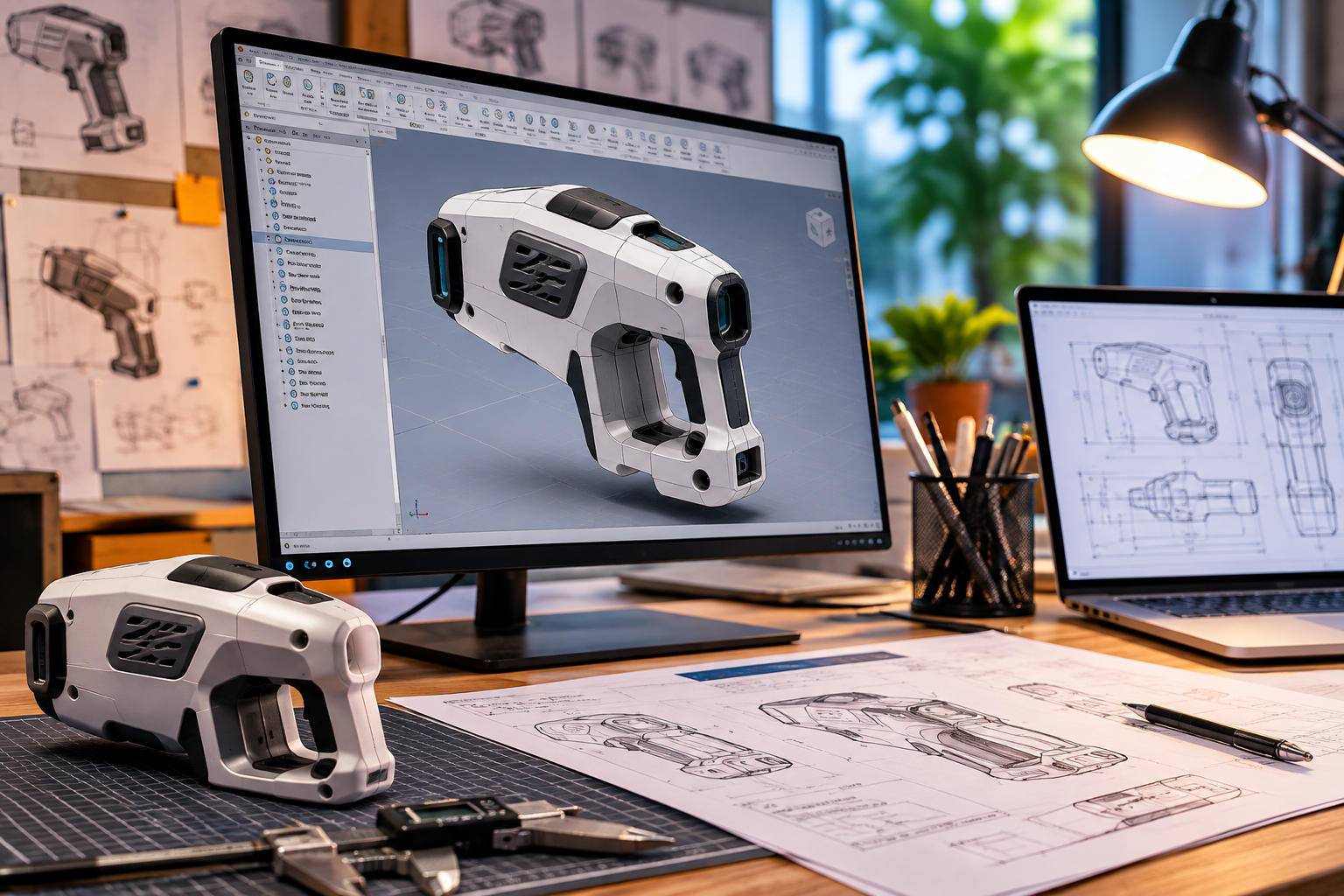
Product design is the process of developing a product from an initial idea into a practical, manufacturable solution. It combines creativity, engineering principles, 3D CAD modelling, materials, manufacturing considerations, prototyping, testing, and design communication.
For students exploring a Product Design Course in Thrissur, the field offers an opportunity to combine engineering knowledge with digital design skills. Product designers may work on consumer products, industrial components, automotive parts, machinery, electronics enclosures, furniture, tools, and other manufactured products.
The important point is that product design is not simply about making something look attractive. A successful product must also function correctly, be practical to manufacture, meet dimensional requirements, and provide value to the intended user.
A Product Design Course in Thrissur can help students develop skills in 2D drafting, 3D CAD modelling, assemblies, product visualization, prototyping, design for manufacturing, and engineering documentation. These skills can support careers in mechanical design, product development, manufacturing, automotive, engineering services, and related industries.
Key Takeaways
-
Product design combines creativity, engineering, CAD, manufacturing, and problem-solving.
-
3D modelling and technical drawing are fundamental skills for product design professionals.
-
Software such as AutoCAD, Fusion, Inventor, CATIA, SOLIDWORKS, and Creo may be used depending on the industry.
-
Practical projects are more valuable than learning software commands alone.
-
Mechanical and engineering students can benefit from structured product design training.
-
Product designers can work across manufacturing, automotive, consumer products, engineering services, and industrial sectors.
- The right course should match your educational background and intended career direction
How Does Product Design Work in the Real World?
Product design follows a structured development process, although the exact workflow varies between industries and companies. A typical project moves through several connected stages:
Idea → Requirements → Concept → 3D Design → Engineering Validation → Prototype → Testing → Design Changes → Manufacturing
For example, imagine a company developing a new handheld power tool. A product designer may begin by understanding the required dimensions, user requirements, ergonomics, materials, and manufacturing method.
The designer then creates concepts and develops the selected concept into a detailed 3D model. Components are assembled digitally to check fit and movement. A prototype may then be produced for physical testing before the design is released for manufacturing.
Modern product development platforms increasingly connect CAD, simulation, manufacturing, collaboration, and data management. Autodesk describes product development as a process covering stages such as ideation, concept development, design, prototyping, testing, and manufacturing.
What Do You Learn in a Product Design Course in Thrissur?
A good product design program should teach more than individual software commands. It should explain how CAD tools fit into an actual product development workflow.
Typical learning areas include:
1. 2D Technical Drawing
Students learn how to create accurate engineering drawings, dimensions, annotations, and layouts. Technical drawings communicate design intent to engineers, manufacturers, suppliers, and other project stakeholders.
BIS notes that technical drawings communicate information such as geometry, dimensions, materials, and tolerances and are important for manufacturing.
2. 3D CAD Modelling
3D modelling allows designers to develop digital representations of individual components before physical production.
Depending on the course and industry, learners may work with parametric modelling, assemblies, surface modelling, sheet-metal tools, and design configurations.
3. Assembly Design
A product rarely consists of one component. Students need to understand how individual parts fit together and how assemblies behave.
For example, designing a gearbox cover requires consideration of mounting points, clearances, fasteners, mating components, and manufacturing constraints.
4. Product Visualization
Visualizations help communicate the appearance and form of a product before manufacturing. They can also help designers and clients review concepts more effectively.
5. Design for Manufacturing
Design for Manufacturing, or DFM, means developing products with the manufacturing process in mind. A component that looks excellent on screen may still be expensive, difficult, or impossible to manufacture efficiently.
This is why product design education should connect modelling with manufacturing knowledge.
Which Software Is Used in Product Design?
The right software depends on the industry, company, and type of product being developed. There is no single CAD program that is best for every product design career.
Common tools include:
|
Software |
Typical Application |
|
AutoCAD |
2D drafting and technical documentation |
|
Autodesk Fusion |
3D CAD, prototyping and integrated product development |
|
Autodesk Inventor |
Mechanical design and assemblies |
|
SOLIDWORKS |
Mechanical modelling and product development |
|
CATIA |
Advanced product and engineering design |
|
Creo Parametric |
Parametric mechanical product design |
|
VRED |
Product visualization and presentation |
|
ANSYS/Nastran |
Engineering simulation and analysis |
Autodesk Fusion, for example, combines 3D design with capabilities connected to simulation, manufacturing, collaboration, and product development workflows.
At CAD CENTER, the published product design programs include software options such as AutoCAD, Fusion 360, Autodesk Inventor, CATIA, SOLIDWORKS, Creo, VRED, and ANSYS/Nastran depending on the selected program.
Students should therefore choose software based on their target role rather than trying to learn every available package.
Who Should Consider a Product Design Career in Thrissur?
A Product Design Career in Thrissur can be suitable for students and professionals who enjoy engineering, problem-solving, manufacturing, and digital modelling.
The field can be particularly relevant for:
-
Mechanical engineering students
-
Aeronautical engineering students
-
Production engineering students
-
Diploma holders
-
Engineering graduates
-
CAD learners
-
Manufacturing professionals
-
Professionals looking to move into design roles
Basic computer skills are generally useful when starting. Advanced programs may have additional prerequisites depending on their technical depth.
CAD CENTER's published product design program is intended for students and professionals from areas including mechanical and aeronautical engineering, along with project managers, and lists basic computer skills as a prerequisite.
What Skills Do Product Designers Need?
Software proficiency is important, but successful product designers need a wider combination of technical and professional skills.
Core technical skills
-
2D technical drawing
-
3D CAD modelling
-
Parametric design
-
Assembly modelling
-
Surface modelling
-
Engineering documentation
-
Material awareness
-
Manufacturing knowledge
-
Basic tolerance understanding
-
Prototyping concepts
-
Design for Manufacturing and Assembly
Professional skills
-
Problem-solving
-
Design thinking
-
Attention to detail
-
Communication
-
Team collaboration
-
Time management
-
Ability to interpret requirements
-
Willingness to revise designs
A strong designer should be able to explain why a design was created in a particular way—not simply demonstrate which CAD command was used.
What Career Opportunities Are Available After Product Design Training?
Product design skills can support several entry-level and developing career paths.
Possible roles include:
-
Junior Product Designer
-
Product Design Engineer
-
CAD Designer
-
Mechanical Design Engineer
-
3D CAD Modeller
-
Design Engineer
-
Product Development Engineer
-
CAD/CAE Engineer
-
Prototype Design Assistant
-
Manufacturing Design Support Professional
The actual role and salary depend on qualifications, software proficiency, portfolio quality, experience, location, and employer requirements. Students should avoid choosing a course based on salary claims alone.
The Government of India's National Career Service provides job-search, career guidance, job-matching, and employment-related services that can also help learners research roles and opportunities.
Which Industries Hire Product Design Professionals?
Product designers can work across a broad range of industries because physical products require design and engineering at many stages.
Relevant sectors include:
-
Automotive
-
Consumer products
-
Manufacturing
-
Industrial equipment
-
Machinery
-
Electronics
-
Aerospace
-
Medical equipment
-
Plastics and moulded products
-
Engineering consultancies
-
Product development companies
-
Tool and die manufacturing
For example, an automotive company may need designers for vehicle components, while a consumer-product manufacturer may need designers for housings, mechanisms, and physical product forms.
This flexibility is one reason product design can be an attractive option for engineering students who want to move beyond conventional drafting roles.
How Should Students Choose a Product Design Institute in Thrissur?
Choosing a Product Design Institute in Thrissur should be based on the quality of training rather than the number of software names listed in a brochure.
Before enrolling, compare these factors:
-
Curriculum: Does it cover the complete product development workflow?
-
Software: Are the tools relevant to your target industry?
-
Practical projects: Will you create complete products rather than isolated exercises?
-
Trainers: Can instructors explain both software and engineering applications?
-
Portfolio: Will you have meaningful projects to demonstrate your skills?
-
Certification: Understand exactly what certificates are awarded.
-
Facilities: Check whether suitable CAD systems and practical learning resources are available.
-
Career support: Ask what placement or career guidance is currently offered.
CAD CENTER's published product design curriculum specifically covers product development, manufacturing considerations, DFM/DFA, costing, prototyping, simulation, and software-based workflows.
Why Practical Projects Matter More Than Software Commands
A student who knows 50 CAD commands but cannot develop a manufacturable component still needs more practical experience.
A better learning project could involve designing a small consumer product from concept to final documentation. The learner might:
-
Define the product requirements.
-
Sketch initial concepts.
-
Build the 3D model.
-
Develop individual components.
-
Create the assembly.
-
Check dimensions and clearances.
-
Consider manufacturing methods.
-
Produce technical drawings.
-
Prepare a prototype or visualization.
-
Revise the design based on feedback.
This approach creates a stronger connection between classroom learning and actual engineering work.
What Role Do Standards Play in Product Design?
Standards help designers and manufacturers communicate consistently and develop products that meet defined requirements. Depending on the product and market, designers may need to consider dimensions, tolerances, materials, safety requirements, testing procedures, and applicable regulations.
The Bureau of Indian Standards provides access to Indian Standards and product-specific information, while its engineering resources highlight areas such as limits, fits, tolerances, technical drawings, and standardization.
Students do not need to memorize every standard. They should, however, understand why standards matter and learn how to identify the relevant requirements for a particular project.
A Practical Learning Roadmap for Students
If you are starting from the beginning, a practical progression can look like this:
Stage 1: Learn engineering drawing fundamentals.
Stage 2: Develop 2D CAD drafting skills.
Stage 3: Move into 3D parametric modelling.
Stage 4: Learn assemblies and product documentation.
Stage 5: Understand materials and manufacturing processes.
Stage 6: Explore simulation and prototyping.
Stage 7: Complete portfolio-level product projects.
Stage 8: Apply for internships, junior design roles, or further specialization.
The roadmap can be adjusted according to whether your goal is mechanical design, automotive design, consumer products, manufacturing, or another specialization.
CAD CENTER: Building Product Design Skills Since 1989
CAD CENTER has been providing CAD and engineering software training since 1989, with a focus on industry-oriented technical education. Its training portfolio covers mechanical CAD, product design and manufacturing, BIM, civil engineering, MEP, architecture, project planning, and other technical disciplines.
Its published product design programs include practical areas such as product development, manufacturing, prototyping, simulation, DFM/DFA, and CAD software workflows. The institute also lists Autodesk course completion and online examination certificates for relevant programs.
For students specifically looking for training locally, CAD CENTER has a training centre in Thrissur and offers practical CAD and engineering programs for students and professionals.
You can explore the Product Design and Manufacturing programs, Mechanical CAD training, or the wider CAD CENTER course catalogue to compare available learning paths.
Ready to Explore a Product Design Career in Thrissur?
A Product Design Course in Thrissur can be a useful starting point for students who want to build practical CAD, 3D modelling, product development, and manufacturing-related skills.
Before choosing a program, compare the curriculum, software, practical projects, trainer support, certification, and career relevance. Your best option will depend on your educational background and the type of product design role you want to pursue.
If you are exploring your options, you can visit CAD CENTER's Thrissur training centre or explore CAD and engineering courses to understand the currently available programs.
Frequently Asked Questions
1. What is product design?
Product design is the process of developing a product from an idea into a functional, manufacturable solution. It involves concept development, CAD modelling, engineering drawings, materials, prototyping, testing, and manufacturing considerations.
2. Is a Product Design Course in Thrissur suitable for beginners?
Yes, some programs accept learners with basic computer skills. However, eligibility varies by course. Engineering and diploma students may find advanced product design programs particularly relevant because they already have foundational technical knowledge.
3. Which software is best for product design?
There is no single best software for every product design role. Autodesk Fusion, Inventor, CATIA, SOLIDWORKS, and Creo are used for different workflows and industries. The best choice depends on your target career and the software used by employers in that field.
4. What can I do after product design training?
You can explore roles such as CAD designer, product design engineer, mechanical design engineer, 3D CAD modeller, product development engineer, or design support professional. Career progression depends on your qualifications, portfolio, technical skills, and experience.
5. Is product design a good career for mechanical engineering students?
Yes. Mechanical engineering provides a useful foundation in materials, manufacturing, mechanics, and engineering principles. Product design training can add practical CAD modelling, assembly design, visualization, prototyping, and documentation skills.
6. How long does it take to learn product design?
The learning time depends on the course level, software covered, previous technical knowledge, and amount of practical work. Basic CAD skills can be learned relatively quickly, while professional product design capability requires continued project practice and industry exposure.
7. What should I look for in a Product Design Institute in Thrissur?
Look for a practical curriculum, experienced trainers, relevant CAD software, product-based projects, manufacturing concepts, portfolio development, certification details, and career support. The institute should teach how software is applied to real product development rather than focusing only on commands.
8. Can product design skills be used in manufacturing?
Yes. Product design and manufacturing are closely connected. Designers need to consider materials, tolerances, manufacturing processes, assembly, cost, and production requirements. Understanding Design for Manufacturing can help create products that are easier and more economical to produce.
← Back